
Creative Agency Workflows: Automate Everything but the Work
Ask most people how to improve a creative agency workflow and they'll start listing tools. Alex Oesterle starts with a different question: what are clients actually paying us for?
For Blue Bear Creative, the Denver-based social media agency Alex runs with his wife and co-founder, the answer is creative work for established food and beverage brands. Everything else, from hiring admin, the file chasing, the reporting, the follow-up emails…is all overhead. And overhead, in Alex's view, exists to be systematized.
"It goes back to what's value-add, what's just part of delivering the service, and what's possible to automate," he says. "Ideally you're making everything else take the least amount of time possible and reinvesting that time into the work itself."
It's a simple philosophy with a decade of trial and error behind it. And it comes with a warning label, because Blue Bear also learned what happens when you push efficiency one step too far.
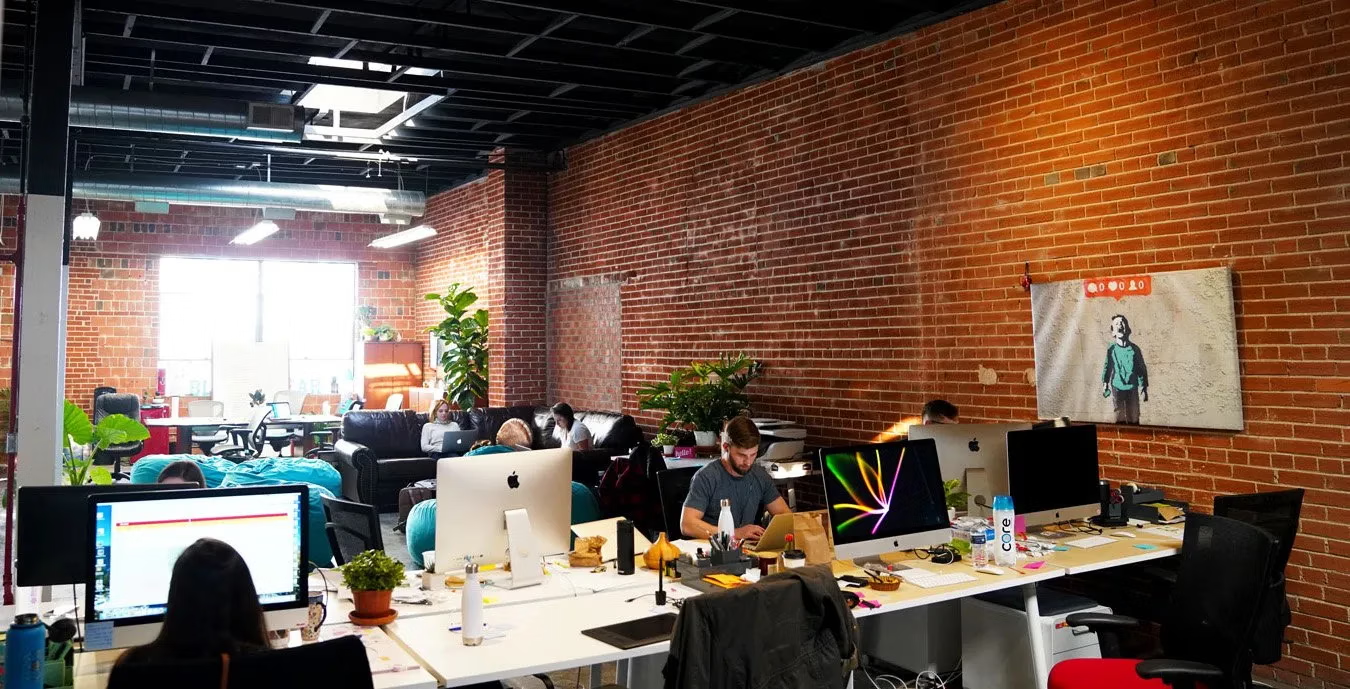
From soul-crushing finance to a 12-person agency
Alex didn't set out to run an agency. He was working in finance, aiming for Wall Street, and found the industry soul-crushing. He exited into a startup, ran finance there, and started absorbing marketing and operations work along the way. When he and his wife landed a couple of side marketing projects that went well, Blue Bear was born.
The original spark was frustration as much as opportunity. "There was so much marketing content aimed at us as consumers that was just garbage," Alex says. "We thought, somebody has to be able to do this better."
His wife's background in social and PR for food and beverage gave them a foothold, and Colorado's dense ecosystem of fast-casual restaurant chains and natural food brands gave them a market. Ten years later, Blue Bear is a 12-person team working with established food and beverage brands, CPG companies, and restaurant chains, handling everything from strategy to content production to paid social.
Twelve people. Sizable clients. Large engagements. The math only works because of how the company operates.
First, decide what you don't do
Before Blue Bear could automate anything, it had to figure out what it was. Like a lot of young agencies, it started by offering everything: website development, social, email marketing, the full digital menu. "We thought we were being super unique," Alex says. "Then we found out there were thousands of other digital agencies doing the exact same thing."
What followed was years of listening to a feedback loop. Which services made clients happy? Which ones were a grind no matter how much extra effort went in?
"There were components of the service where no matter how hard we tried, no matter how far over scope we went, it would always be a battle," Alex says. Email marketing was the clearest case. "It was a huge pain and it was barely making any money for us."
So they cut it. And kept cutting, until the list of things Blue Bear doesn't do became as defining as the list of things it does. "We weren't building any competitive advantage by being okay at some services and pitching those just to win a client, as opposed to doubling down on what was working."
This matters for the automation story because focus is what tells you where to invest. Once Blue Bear knew that creative work for social was the product, everything surrounding it became a candidate for systems.
Automating the hiring workflow
Take hiring. A 12-person agency that works with big brands can't afford to lose days to administrative back-and-forth, and hiring is full of it.
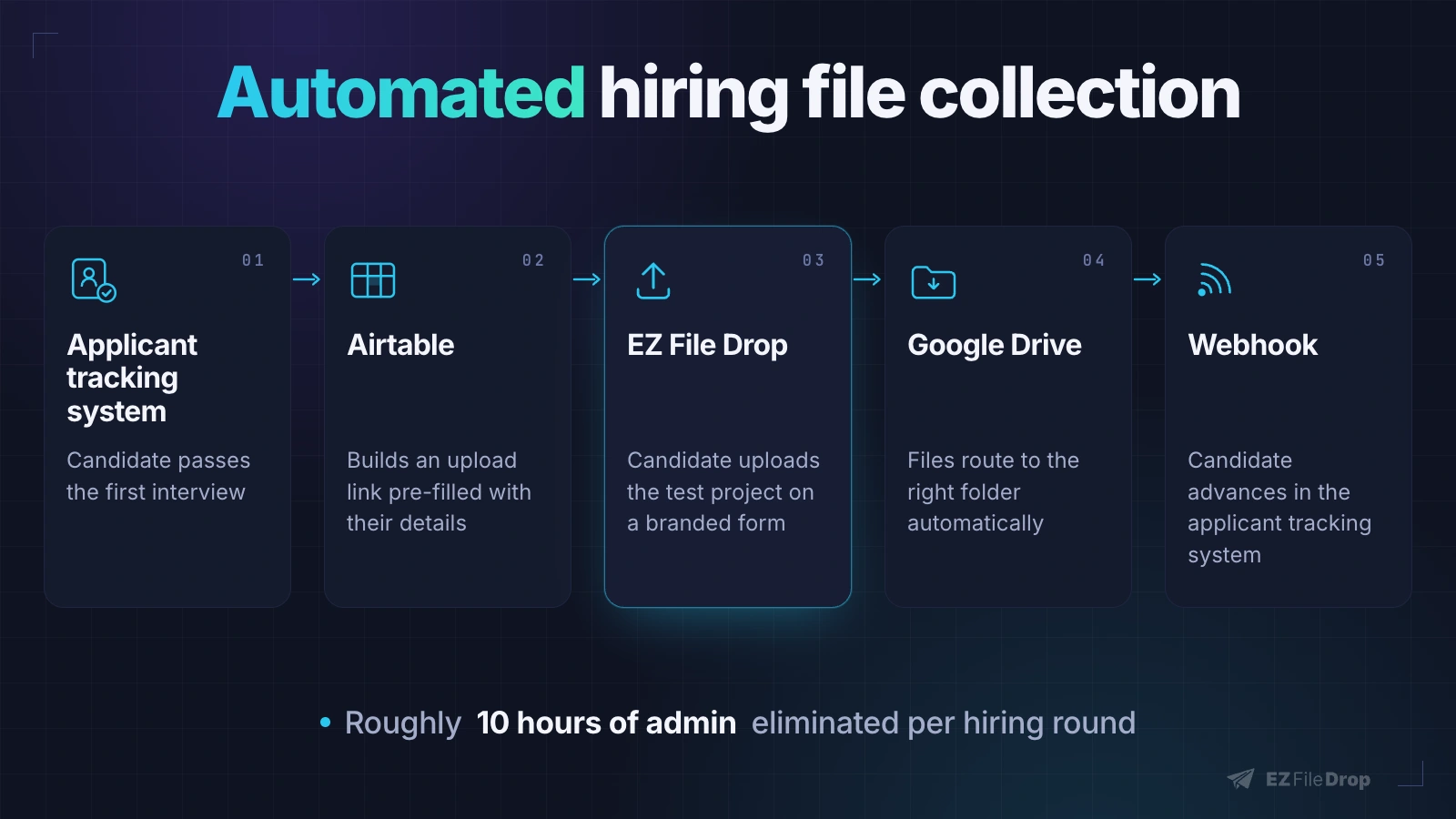
Blue Bear's hiring process automation runs on an applicant tracking system connected to Airtable. When a candidate advances past a first interview, Airtable automatically builds a personalized upload link, pre-filled with the candidate's name and details using URL parameters, and sends it in an automated email inviting them to submit a test project. The candidate clicks, uploads their work, and the file lands where the team needs it. The hiring team gets notified, and a webhook moves the candidate to the next stage automatically.
The upload step runs through EZ File Drop, which Blue Bear plugged into the system years ago. "Previously we were having people send file attachments, or trying to figure out the file request feature in Google Drive or Dropbox, and it was super clunky," Alex says. "It required a person to go look and confirm that they actually sent it."
Now, nobody checks anything. "It's been so turnkey that we basically set it up at the beginning and have barely touched it since. It's one of the few tools in that stack that doesn't break."
Alex's rough math: a typical hiring round means test projects from 20 to 30 candidates, each of which used to eat 20 to 30 minutes of chasing and confirming. Call it 10 hours of admin per hire, eliminated by EZ File Drop.
The creator pool: collecting files from 150 contractors
The bigger workflow is Blue Bear's creator pool, a network of roughly 150 contract creators who film content that the in-house team edits and quality-controls. It's how a 12-person agency produces at the volume its clients need.
The system mirrors the hiring one. Airtable generates a unique upload link for each creator and each project, pre-filled with the client and creator details. Creators film, click their link, and upload, sometimes a large batch of files at once. Everything syncs automatically to the correct Google Drive folder, and the creative team gets an email notification that files are ready to edit.
No follow-up emails. No "did you get my files?" No human in the loop confirming delivery. Alex estimates the workflow saves about an hour per video, across 5 to 10 videos a week.
"It seems like something that would be so simple," he says, "but it wasn't, until we found EZ File Drop."
Across all of Blue Bear's automations…hiring, creator uploads, reporting, briefing, Alex estimates the team saves somewhere between 50 and 100 hours per week. For a team of 12, that's a meaningful fraction of the company's total capacity, recovered and redirected toward the work clients actually pay for. It's the same problem marketing and creative agencies of every size run into: the work scales, and the file chasing scales right along with it unless something absorbs it.
Where automation breaks: the creative itself
Here's the part most efficiency content leaves out. Blue Bear tried to apply the same discipline to the creative work, and it backfired.
"Building SOPs around creative work is just so difficult, because you can't process out the spark of inspiration," Alex says. Some people on his team take hours and produce one brilliant idea. Others generate a hundred ideas to find two good ones. Creative work doesn't fit a template.
At one point, Blue Bear tried setting maximum time limits on concepting and editing. The result: "The content coming out was just not as good. That might technically be what clients are paying for if you're looking at the hours, but that's not what we want to be known for. That's not how we're going to win the business we want to win."
So they took the reins off. The rule today is the one Alex started with: overhead gets systematized. The creative work doesn't. Especially now, Alex argues, that boundary matters more than ever. "With everything AI can do, the creativity piece is what us humans still have as a competitive advantage."
The new scoreboard: revenue per employee
The payoff for all of this shows up in how Alex measures the business. "I used to look at success as the number of full-time employees we had. That was the proxy for growth," he says. "Now it's revenue per full-time employee."
That's a quiet but significant shift, and it's the real reason the automation philosophy matters. Headcount growth means more revenue and more overhead in roughly equal measure. Revenue per employee only grows when you remove work that doesn't create value, and protect the work that does.
A creative agency workflow playbook in three moves
For anyone building a service business, Alex's playbook for a creative agency workflow condenses to three moves:
- Figure out what clients are actually paying you for. Be honest about it, and be willing to cut services that are a grind, even when they look like revenue.
- Automate everything around that core. Hiring admin, file collection, reporting, follow-ups. Build systems with a fast feedback loop, and be ready to pivot when something isn't working.
- Don't automate the core itself. The thing clients pay for deserves more time, not less. The whole point of the systems is to buy that time back.
"It's not a linear process," Alex says of the decade it took to get here. "Have a quick feedback loop and be ready to pivot. That's the takeaway."
Blue Bear Creative uses EZ File Drop to deliver creator and candidate uploads into Google Drive, no chasing required. Learn more at ezfiledrop.com.
Written by Matt Townley