
Construction Technology That Feels Personal: How US Custom Creations Wins the High-End Home
Most homeowners brace themselves before hiring a contractor. They expect a truck with Mountain Dew bottles on the dash and fast-food wrappers stacked to the window, a guy who shows up late, scribbles a number on a carbon-copy form, and disappears for three weeks.
US Custom Creations upends that expectation with a construction sales process that starts before a salesperson ever pulls into the driveway. A prospective customer told them last week that their website simply hooked her. "It drew me right in," she said. That reaction is the whole strategy in miniature. In a trade where the expectation is a sweaty handshake and a hand-written estimate, US Custom Creations decided to feel like a luxury brand, and got there by leaning into the exact thing most contractors avoid: technology.
A screen company that runs like a software company
US Custom Creations designs and installs outdoor living systems across Kentucky and Ohio, from its Louisville and Cincinnati branches out into southern Indiana and the towns in between. Owner Alex Rutherford started the company in 1995 with an under-deck drainage system, the kind that keeps the space beneath a raised deck dry enough to hang a kitchen or a living room under it. About fifteen years ago, he added motorized retractable screens, roughly as long as they've been available to American homeowners. Drop-down, remote-operated screens that block sun, bugs, and prying eyes at the push of a button. Louvered pergolas and interior motorized shades followed, the shades running on the same motors as the exterior screens.
What's unusual is how it operates once you look past the trucks and ladders. There is, as regional manager Tyler Cox puts it, "literally nothing on paper." Every installer carries an iPad, and nearly every conversation, schedule, time clock, and customer record lives inside one system. For a company that bolts physical products onto the backs of houses, it behaves more like a software startup than a screen installer.
The backpack full of manila envelopes
The company runs on modern technology today, but it wasn't built that way. Only a few years ago it was almost entirely analog. When Tyler joined in April 2019, Alex was still running the business out of a backpack.
"He carried this thing around everywhere, stuffed with manila envelopes," Tyler says. "The contract was a carbon copy inside, and he'd sketch the job on the back of the envelope. My first week, he brought me ten file boxes full of them." Alex swapped out a year's worth of envelopes at a time. Tyler, still amused by it years later, remembers razzing his new boss the first time he saw the load. "I told him, I can't believe you haul all this around," he says, laughing. "You look like a camel."
Tyler came in with a business management degree and the kind of background most screen companies never think to hire for. He built computers as a kid. He was comfortable with software. His entire first job was to digitize the company, scanning years of carbon-copy contracts into the cloud and standing up a real construction CRM, Buildertrend, to run new work. He spent six months installing product in the field so he'd know what he was talking about, then a year and a half rebuilding the back office. Only after that did he move into sales.
That sequence matters, because the modernizing came first and the growth came after.
Everything is a documented process
The engine underneath all of it is Alex's refusal to sit still. "Complacency is his least favorite word," Tyler says. Every stage of a customer interaction is written down as a standard operating procedure and run the same way every time. The point isn't rigidity. It's that anyone can pick up any step.
"The goal is to have everything in place so you could switch seats if you needed to," Tyler says. Alex uses a school-bus analogy with the team: everyone has a seat, everyone wants to be on the bus, and the bus keeps moving down the road together.
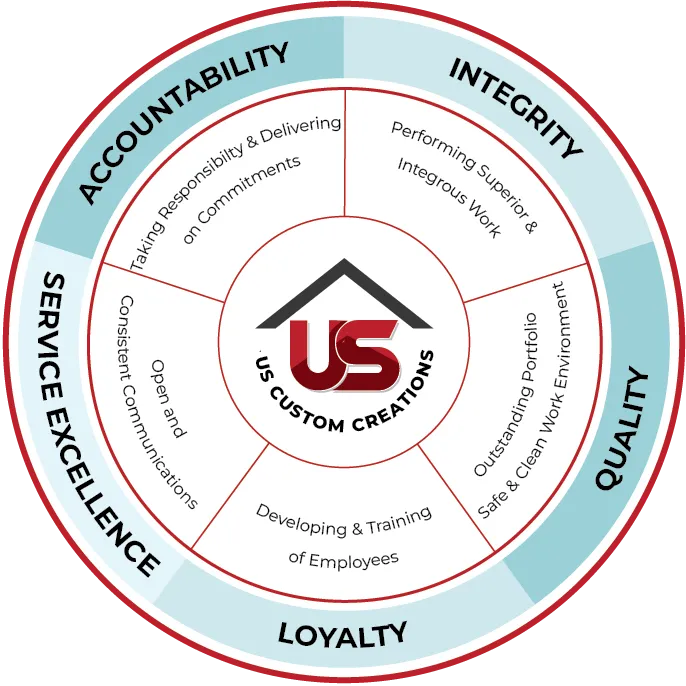
Accountability sits at the bottom of every meeting slide. Not everyone takes to that, and the ones who don't tend to realize it early. The standards here run higher than at many traditional construction companies: uniforms, app-based clock-ins, and clear expectations for how a customer's home is treated. "It makes this a much better place to work, because nothing's personal," Tyler says. "Either the box is checked or it isn't. Let's get it checked."
The pandemic, and the one-photo problem
For a company built to remove friction, COVID was less a disruption than an accelerant. Homeowners were suddenly living in houses they'd barely occupied, staring at bare patios, and the upgrade work poured in. But the same homeowners no longer wanted a stranger in their living room.
"Before COVID, almost nobody would send you pictures," Tyler says. "Everyone wanted you to come out and look. Then overnight it flipped. People would say, I'll send you some photos, just get me an accurate number." Suddenly the company needed to quote jobs it could not physically visit, which meant it needed a clean way to get real images of a customer's space.
Their CRM couldn't do it. At the time, the website contact form in Buildertrend accepted exactly one photo. One photo is useless for pricing a custom screen enclosure across a wraparound porch. So when the company brought in Scott McNiel of GoDev Technologies, the outside firm that runs its website, SEO, and digital ads, fixing that jumped to the top of his list.
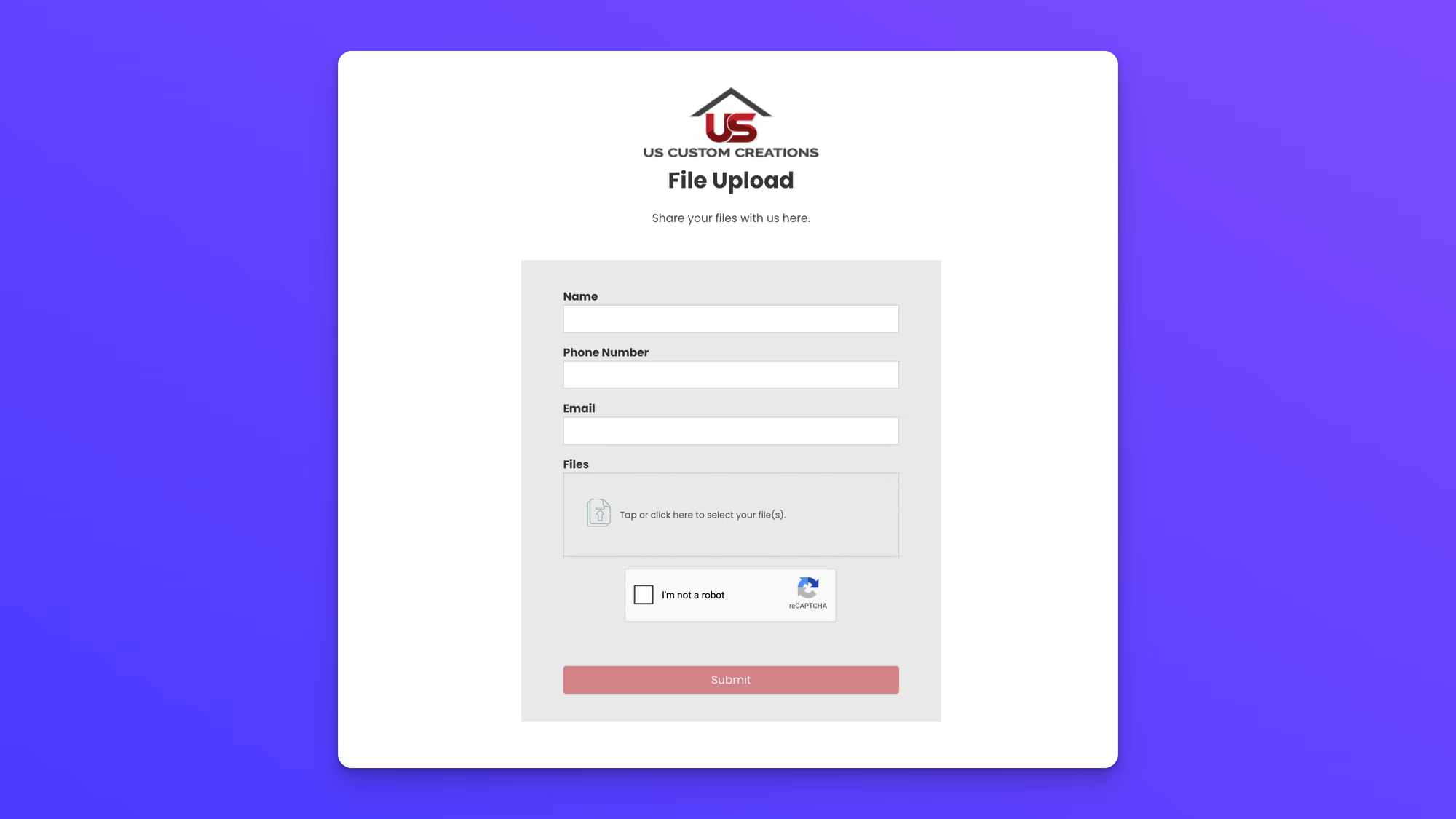
"Integrating EZ File Drop was one of the first things I did," Scott says. "Alex came to me right away with the pain point. We had to solve it." The fix was clean. When a homeowner reaches out, they're guided into a simple upload form where they add all their photos and measurements in one place. The files are delivered to the company's Google Drive and the office is notified the moment they arrive, easily accessible and already organized for the team.
"It just works," Tyler says. "We set it up years ago and I never have to think about it. So few things work that well."
The construction sales process, minute by minute
The moment a homeowner's photos and measurements come in, US Custom Creations runs a sequence engineered down to the minute. The goal is to call every new lead back within the first five minutes. On that first discovery call, the salesperson learns about the customer's goals: sun, privacy, or a dry space to build under. Because the photos and measurements are already in hand, they can give a real price range on that first call.
Then comes the part that separates them even more. Every quote they send includes an interactive presentation, tailored to the product line, including options and photo galleries. The quote is packaged next to something that looks premium, which builds brand equity and trust before anyone ever meets in person.
Only then does a salesperson come out, and it's one visit: revisit the goals, measure, write the proposal on site, collect the deposit, and order the screens before pulling out of the driveway. They've even thought about their project closeout. The install crew hands over a miniature 5-gallon bucket holding the customer's new remote and two cards: one for referrals and one to leave a Google review. Every step has been tightened to feel less like a construction project and more like the purchase experience you'd expect from a luxury car brand.
Stripped to its bones, the sequence runs like this:
- Call back within five minutes. Every new lead, no exceptions.
- Run the discovery call with the photos and measurements already in hand.
- Give a real price range on that first call, because the information is already there.
- Send the quote packaged with an interactive presentation tailored to the product line.
- Let the customer explore it on their own time rather than walking them through it.
- Make one site visit that measures, writes the proposal, collects the deposit, and orders the product.
- Close out with the remote, a referral card, and a review card.
The trap they had to avoid
Here's the tension most contractors get wrong when they try this. Systematize too aggressively and you strip out the human warmth that made customers trust you in the first place. US Custom Creations knows, because they did it, and pulled back.
An earlier version of their discovery call process had salespeople reading the presentation to customers over the phone. Click here, scroll here, look at this gallery. It felt like a script. "People found it robotic," Tyler says. "It was like, geez, I called you for a price on a screen, just let me look at it myself." So they cut it. Now they send the quote and the presentation and let the customer explore it all on their own time, saving the human energy for the in-person visit where it counts.
That's the real lesson, and it runs against the usual fear that going high-tech means going cold. The technology isn't there to replace the person in the truck. It clears away everything that used to get in that person's way: the lost paperwork, the slow callbacks, the wasted site visits. The human part gets to be better. Tyler even frames AI that way: "It'll get you eighty percent of the way, but you always need the human touch to iron out the last twenty and make sure it's right." In a trade that treats technology and craftsmanship as opposites, US Custom Creations uses technology to empower their craftsmanship.
Customers feel the difference, and they pay for it. "We hear it all the time," Tyler says. "You're more expensive than everyone else who quoted us. But you were the first to call back, the first to come out, your price never changed, and you did the job when you said you would. That's why we picked you." They are rarely the cheapest bid and they win anyway.
What a documented construction sales process is worth
The payoff shows up in the numbers Alex watches most closely. Since committing to documented processes and joining the Certified Contractors Network six years ago, Alex reports the company has increased its profitability five fold. By the network's own figures, a typical contractor's referral rate runs around 55 percent, while member companies average closer to 97 percent. Less frantic work and more return.
It's also a business that founder and owner Alex can begin to step away from. He spends more of his time now thinking about his granddaughter than his next install, which is the quiet goal under all the systems: build something that runs without him.
That handoff is already in motion. Tyler is working to buy in as a partner, taking on ownership responsibilities and spending part of each week at the Cincinnati branch to train the next round of office staff and salespeople, the same way Alex once trained him. A company built on documented, repeatable process is one that can change hands without losing a step, and that may be the truest test of everything they've built.
Ask Tyler what he'd tell another contractor who knows they should modernize but has no idea where to start, and he grins knowing how Alex answers that question. "Find you a Tyler." Behind the joke is real advice. Find the person who genuinely believes in your mission, embraces change with enthusiasm, who can translate between what the owner is trying to build and what the crew can actually absorb, and turn them loose. You don't have to become a technology company overnight. You just have to stop carrying the backpack.
US Custom Creations collects the photos and measurements it needs to quote jobs remotely through EZ File Drop: branded, secure, no logins, no chasing. See how it works at ezfiledrop.com.
Written by Matt Townley